Outsourced SDR Services in New Zealand: A Guide for B2B Tech

Outsourced SDR Services in New Zealand: A Guide for B2B Tech
Updated November 2026. How outsourced SDR works when your buyers are in Auckland, Wellington and Christchurch, and what changes compared with selling in Australia.
An outsourced SDR for New Zealand is an external sales development rep who calls your NZ target accounts, qualifies them and books meetings for your account executives. The hard parts aren't the pitch. They are a small, concentrated buyer pool, a time zone two hours ahead of Sydney (three for one week a year), and different rules for calls and email.
I'm Jamie Partridge, founder of Uplift Sales. We are a phone-only SDR agency for B2B technology companies, and we call New Zealand from Sydney as part of the same programme that covers the Australian states. This is the NZ companion to our Australian buyer's guide to outsourced SDR, and every NZ market and legal fact below links to an official source.
The short answer
| Question | Short answer |
|---|---|
| Can a Sydney SDR cover NZ? | Yes. NZ is usually 2 hours ahead, so NZ mornings are early Sydney mornings |
| Where are the buyers? | Auckland region has 35% of NZ business locations and employees; Canterbury and Wellington follow |
| How big is the market? | 620,150 enterprises, but 74% have no paid employees and only 2,810 have 100 or more |
| Do the NZ spam rules cover calls? | No. The Unsolicited Electronic Messages Act 2007 covers email, text, fax and instant messages, not phone calls |
| Is there a Do Not Call register? | A voluntary consumer service run by the Marketing Association, not a government register |
| How fast are first meetings? | With Uplift Sales, usually weeks 2 to 3 |
What an outsourced SDR does, and why companies use one for NZ
A sales development representative does the top-of-funnel work: researching accounts, finding the right decision makers, making the first contact, qualifying interest and booking a meeting for an AE. An outsourced SDR does the same job, but the rep, the calling setup, the data and the management come from a provider rather than your own payroll.
Companies tend to outsource NZ outbound for a handful of reasons:
- NZ is the second market, not the first. Most Australian B2B tech companies sell into NZ after they have a base in Australia. The NZ pipeline target is real but often too small to justify a dedicated hire.
- No one owns NZ. Australian SDRs work the east coast, and NZ gets whatever time is left, usually the wrong time for NZ buyers.
- Testing before committing. An outsourced programme shows within a quarter whether NZ buyers take meetings, before you set up an entity or hire locally.
- Overseas vendors entering ANZ. For a US, UK or European vendor, one Sydney-based team covering both countries is simpler than two separate launches.
The New Zealand market for B2B tech
A concentrated market
Stats NZ's business demography statistics at February 2026 (provisional) give the clearest picture of how the market is shaped:
| Measure (February 2026) | Figure |
|---|---|
| Enterprises in New Zealand | 620,150 |
| Enterprises with no paid employees | 74% |
| Enterprises with one or more employees | 161,560 |
| Large enterprises (100 or more employees) | 2,810 |
| Share of all employees working in those large enterprises | 49% |
| Auckland region share of business locations and employees | 35% |
| Canterbury share of employees / business locations | 14% / 13% |
| Wellington region | 277,000 employees, 61,480 business locations |
Two things follow. First, the headline number misleads: most NZ enterprises have no staff, so the companies big enough to buy mid-market or enterprise software are a small fraction of it. Second, buyers cluster in Auckland, Wellington and Canterbury (Christchurch), and Wellington matters more than its size suggests if you sell to government. With a list this small, the quality of each conversation matters more than raw call volume.
Relationship-driven buying
New Zealand is a small business community. Senior buyers there are often more likely to know each other, ask peers about a vendor, and remember a careless first call. That rewards a clear reason for calling, a real question about their situation, and taking "not now" gracefully. Aggressive volume tactics can follow you around in a market this size.
Smaller companies, broader roles
With only a few thousand large enterprises, many NZ targets are mid-sized businesses where one person covers several functions. The head of IT may also own security; the CFO may sign off software. Qualify on the actual decision process rather than assuming an Australian-sized buying committee.
Selling from Australia into New Zealand
NZ buyers notice when a pitch is an Australian one with "and NZ" tacked on. A Sydney-run programme lands better when you:
- Reference NZ customers or partners if you have them, and don't pretend to if you don't.
- Say who will support them, in which time zone, and whether pricing is in NZD.
- Use scripts written for NZ. Our guide to call openers and structure covers the framework; the examples need local tuning.
Want NZ buyers called properly from day one? Uplift Sales runs NZ calling from Sydney inside the same phone-led programme that covers the Australian states. See how our outsourced SDR service works.
Time zones: Sydney to New Zealand call windows
The rule
New Zealand runs on NZST (UTC+12) in winter and NZDT (UTC+13) in summer. Sydney runs on AEST (UTC+10) and AEDT (UTC+11). Because both countries use daylight saving, NZ is two hours ahead of Sydney for most of the year.
The gap moves because the two countries change clocks on different dates:
- New Zealand: the Department of Internal Affairs says daylight saving runs from the last Sunday in September to the first Sunday in April, with clocks going back at 3:00am.
- New South Wales: the NSW Government lists daylight saving starting on Sunday 4 October 2026 and ending on Sunday 4 April 2027.
So in spring NZ moves its clocks forward a week before NSW, and for that week NZ is three hours ahead of Sydney. In 2026 that ran from Sunday 27 September to Sunday 4 October; on current rules, the next runs from Sunday 26 September to Sunday 3 October 2027. In autumn both end daylight saving on the same Sunday (4 April 2027), so the two-hour gap holds.
Call-window table
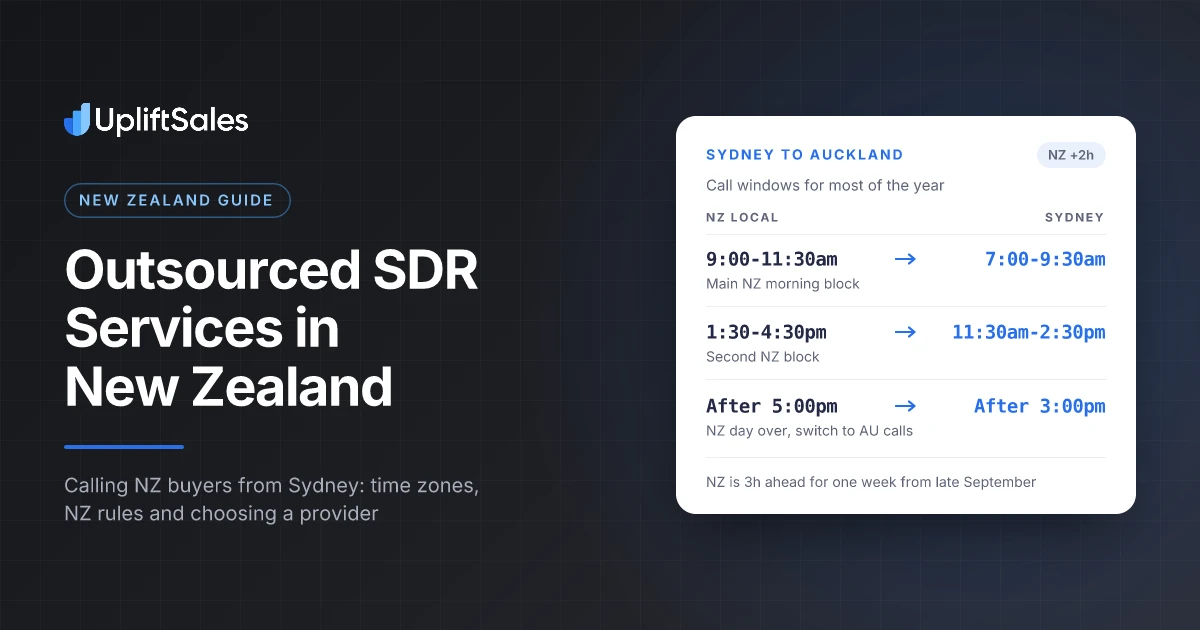
How we plan NZ call blocks from Sydney. NZ times are the prospect's day; the Sydney columns are when your SDR dials.
| NZ local time | Sydney time (most of the year, NZ +2h) | Sydney time (late Sept to early Oct, NZ +3h) | Notes |
|---|---|---|---|
| 9:00am to 11:30am | 7:00am to 9:30am | 6:00am to 8:30am | Main NZ morning block, before Australian calling starts |
| 11:30am to 1:30pm | 9:30am to 11:30am | 8:30am to 10:30am | Lunch period in NZ; lighter NZ calling, switch to the east coast |
| 1:30pm to 4:30pm | 11:30am to 2:30pm | 10:30am to 1:30pm | Second NZ block |
| After 5:00pm | After 3:00pm | After 2:00pm | NZ day is over; Sydney afternoon goes to Australian prospects |
The practical effect: whoever covers NZ from Sydney starts early, because the NZ morning is gone before a 9am Sydney start. Our meeting-booking service plans NZ call blocks the same way.
Holidays that catch Australian teams out
Employment New Zealand lists the public holidays and regional anniversary days. Ones that don't line up with Australia include:
- Waitangi Day (6 February) and Matariki (Friday 10 July in 2026)
- NZ Labour Day, Monday 26 October 2026
- Regional anniversary days, for example Auckland (Monday 26 January 2026), Wellington (Monday 19 January 2026) and Canterbury (Friday 13 November 2026)
Work with UpliftSales
Want an outsourced SDR team booking meetings for you?
UpliftSales is an outsourced sales development agency for B2B technology companies in Australia. Cold calling and appointment setting campaigns, meetings booked into your calendar.
NZ rules for B2B calling and email
NZ's rules differ from Australia's, so don't assume your Australian cold calling compliance maps across.
Unsolicited Electronic Messages Act 2007: email and text, not calls
The Department of Internal Affairs (DIA) enforces New Zealand's anti-spam law. Its guidance for businesses says the Act "covers email, fax, instant messaging, and mobile/smart phone text (TXT)" and "does NOT cover Internet pop-ups or telemarketing such as phone calls." It also warns that failure to comply could mean a fine of up to $500,000.
So the UEMA doesn't govern the call itself. It matters once your team follows up by email or text. DIA's three steps to avoid spamming are:
- Consent. Express, inferred or deemed. Deemed consent applies when someone conspicuously publishes their address (on a website, brochure or magazine) in a business or official capacity, the message relates to their role, and the publication doesn't refuse unsolicited messages. Sitting in your database without unsubscribing is not inferred consent.
- Identify. Clearly identify the sending business, with contact details that stay accurate for 30 days.
- Unsubscribe. A free, working unsubscribe in the same medium, honoured within five working days.
The safest follow-up email is one the prospect asked for on the call.
Privacy Act 2020 and the Information Privacy Principles
A decision maker's name, mobile and email are personal information, so the Privacy Act 2020 applies. The Office of the Privacy Commissioner lists 13 Information Privacy Principles plus IPP3A, which came into force in May 2026. For outbound:
- It reaches overseas businesses. The Commissioner says an overseas agency will be treated as "carrying on business in New Zealand" even without a physical place of business there, for example when it takes payment for goods or services.
- IPP3A covers data from other sources. Under IPP3A, when you collect personal information indirectly (from a data provider, say), you must take reasonable steps to make the person aware of the collection, its purpose, the recipients, your name and address, and their access and correction rights. Exceptions include where you believe on reasonable grounds the information is publicly available, or compliance isn't reasonably practicable. Record which applies to each data source.
- Overseas disclosure and breaches. The same page says NZ agencies must take reasonable steps to protect personal information sent overseas (relevant if an NZ company hires a Sydney agency), and breaches posing a risk of serious harm must be notified to the Commissioner and the people affected.
Fair Trading Act 1986
The Fair Trading Act applies to anyone in trade and is enforced by the Commerce Commission. On a sales call: don't mislead (intent doesn't matter; the overall impression counts), don't make claims you can't substantiate, and don't use unconscionable tactics.
Its uninvited direct sales rules are aimed at consumers. Consumer Protection describes an uninvited direct sale as selling products or services over $100 for personal, domestic or household use. A B2B meeting about business software isn't that, but the misleading conduct rules still apply.
Is there a Do Not Call register?
Not a government one. The Marketing Association runs a Do Not Call service that is "a free service for consumers but does not include businesses," and notes that not every company subscribes, so it is voluntary. For B2B lists, check any personal or sole-trader numbers against it and keep your own suppression list across campaigns.
None of the official NZ sources above sets telemarketing calling hours like Australia's ACMA standard. Calling within NZ business hours is good practice anyway.
This section is general information drawn from the official sources linked, as at November 2026. It is not legal advice. If your programme handles sensitive data or targets sole traders, get advice from a New Zealand lawyer.
How to choose an outsourced SDR provider for New Zealand
Most of the questions we'd put to any SDR provider apply. For NZ specifically, push on five things.
1. Coverage of NZ hours. Ask who calls NZ, at what Sydney time, and what changes in the week NZ is three hours ahead.
2. Local knowledge. Can the SDR pronounce Māori place names properly and talk about the NZ context for your product? Ask for an NZ roleplay before you sign.
3. Data quality for NZ contacts. Don't assume a data provider's NZ coverage matches its Australian coverage, particularly for direct dials. Ask how the provider builds and checks NZ lists, how it records the source of each contact for IPP3A, and how it handles numbers that turn out to be personal.
4. Phone versus email. Calls sit outside the UEMA; cold email needs consent under it. If a provider runs email, ask how it establishes consent and handles unsubscribes.
5. Reporting on meetings held. Insist on reporting that separates meetings booked from meetings held and accepted by your AE.
Need someone to cover the NZ morning? Our Sydney callers book NZ meetings early in the Sydney day, then move to the east coast. Look at our B2B cold calling service.
In-house SDR in New Zealand versus outsourced
What the public salary data shows
Public NZ salary data for SDRs is thin. SEEK's sales development representative salary page for November 2026 shows location averages of about 70,000 to 71,750 NZD, based on salary ranges in employer job ads, some of which include superannuation and benefits. Treat it as a rough marker, not a benchmark.
On top of salary, Inland Revenue says the minimum employer KiwiSaver contribution rose to 3.5% from 1 April 2026, and is set to rise to 4% from 1 April 2028.
The cost lines
The cost categories look much like those in our Australian SDR salary guide:
- Base salary and commission
- Employer KiwiSaver contributions
- ACC levies and other employment on-costs
- A way to employ in NZ if you are an Australian or overseas company (a local entity or an employer-of-record arrangement)
- Tools, data and phone numbers
- Recruitment, management and coaching (often from across the Tasman)
- Ramp time and turnover
When each makes sense
Hire in NZ when NZ is a core market with enough accounts to keep an SDR busy all year, you need someone on the ground, and you have a manager to coach them.
Outsource when NZ is a second market you want to test without setting up locally, you need meetings this quarter, or your NZ list is too small for a full-time hire. Our in-house versus outsourced SDR comparison goes deeper on the trade-offs, and the outsourced SDR cost guide covers pricing models. Whichever way you go, compare options on cost per qualified meeting held.
How Uplift Sales covers New Zealand
We call New Zealand from Sydney, in the same programme that covers Sydney, Melbourne, Brisbane, Perth, Adelaide and Canberra:
- Call blocks in the buyer's time. NZ prospects are called early in the Sydney day, the east coast through the middle of the day and Perth later in the afternoon.
- A dedicated SDR. You get a named SDR who learns your product, your ICP and your NZ accounts.
- Phone only. We don't send cold email, so the UEMA consent questions don't arise from our outreach. Follow-up email your team sends is yours.
- Scripts reviewed with you before launch, written for the NZ buyer rather than copied from an Australian campaign.
- Meetings straight into your AEs' calendars, with handoff notes on every booking and weekly reporting.
A dedicated SDR typically books 8 to 15 qualified meetings a month, and first meetings usually land in weeks 2 to 3. You keep every script, list and playbook we build.
Selling into New Zealand from Australia, or into both from overseas? Talk to us about your NZ market and we'll tell you honestly whether phone-led outbound is a fit.
Sources
- Stats NZ, New Zealand business demography statistics: At February 2026
- Department of Internal Affairs, Daylight Saving ends Sunday, 5 April 2024
- NSW Government, Daylight saving
- Employment New Zealand, Public holidays and anniversary dates
- Department of Internal Affairs, What anti-spam law means for businesses
- Department of Internal Affairs, Three steps to ensure you are not spamming
- Office of the Privacy Commissioner, Privacy principles
- Office of the Privacy Commissioner, IPP3A: Collection of information from another source
- Office of the Privacy Commissioner, What changed between the Privacy Act 1993 and the Privacy Act 2020?
- Consumer Protection (MBIE), Fair Trading Act
- Consumer Protection (MBIE), Telemarketing and door-to-door sales
- Marketing Association, Do not call
- SEEK NZ, Sales development representative salary
- Inland Revenue, KiwiSaver changes
Frequently asked questions
Can an Australian outsourced SDR call New Zealand prospects?
Yes. A Sydney-based SDR can call NZ buyers inside their business day, because NZ is usually two hours ahead of Sydney. NZ morning calls happen early in the Sydney day.
What is the time difference between Sydney and New Zealand?
NZ is two hours ahead of Sydney for most of the year. For about a week from the last Sunday in September it is three hours ahead, because NZ starts daylight saving a week before NSW.
Is B2B cold calling legal in New Zealand?
Yes, with conditions. The Unsolicited Electronic Messages Act covers email, text, fax and instant messages, not phone calls, but calls still have to meet the Privacy Act 2020 and the Fair Trading Act.
Does New Zealand have a Do Not Call register?
Not a government one. The Marketing Association runs a voluntary Do Not Call service for consumers that does not include businesses.
Can I send cold emails to New Zealand businesses?
Only with consent under the UEMA. Deemed consent can apply to a conspicuously published work address if your message relates to the person's role, and every message needs sender details and an unsubscribe honoured within five working days.
How much does an SDR earn in New Zealand?
Public data is thin. SEEK's November 2026 job-ad data shows averages of about 70,000 to 72,000 NZD, plus employer KiwiSaver of at least 3.5%.
How long does an outsourced SDR take to book meetings in New Zealand?
With Uplift Sales, first qualified meetings usually land in weeks 2 to 3 after kickoff.
Founder & CEO of Uplift Sales, an outsourced SDR agency running phone-led cold calling and appointment setting campaigns for B2B technology companies.