Best Time to Cold Call in Australia

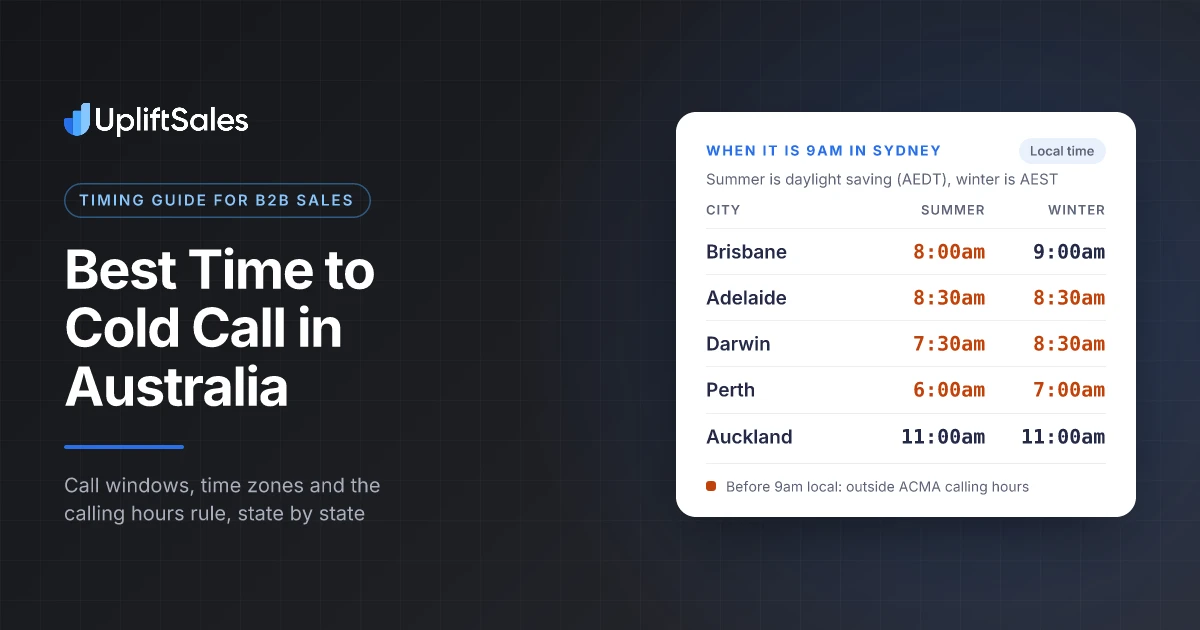
Best Time to Cold Call in Australia
Updated November 2026. The best days and time windows to reach B2B decision makers in Australia, how time zones and the legal calling hours shape them, and how to find the right windows for your own team.
The best time to cold call in Australia is 9:00 to 11:00am and 3:30 to 5:00pm in the prospect's local time, Tuesday to Thursday. For senior buyers, the edges of the day work better: 9:00 to 9:30am and 5:00 to 6:30pm, before their meetings start and after they finish. Nothing before 9am local time, because that is outside the permitted calling hours.
The reasoning is simple. Decision makers spend the middle of the day in meetings, so the first and last hour of their day is when they are most likely to answer their own phone. The catch in Australia is that "their day" depends on where they are: 9am in Sydney is 6am or 7am in Perth, and that call is not allowed.
I'm Jamie Partridge, founder of Uplift Sales. We run phone-only cold calling for B2B technology companies selling into Australia and New Zealand, so time zones and calling hours are part of how every campaign is planned. This guide gives you the windows, the time zone tables and a way to test them on your own market.
The short answer: recommended call windows
All times below are in the prospect's local time, not yours.
| Window (prospect's local time) | Who it suits | Why |
|---|---|---|
| 9:00 to 9:30am | Senior buyers: C-level, VPs, heads of | At their desk before the meeting blocks start |
| 9:30 to 11:00am | Managers, operations and functional leaders | Settled into the day, not yet in back-to-back meetings |
| 11:00am to 3:30pm | Lower priority | Meetings and lunch. Use it for research and admin, but test it |
| 3:30 to 5:00pm | Most B2B buyers | Meetings winding down, often clearing the inbox and the phone |
| 5:00 to 6:30pm | Senior buyers | Calendars are no longer gatekept, still inside the legal hours |
These windows line up with the timing advice in our cold-call playbook, which splits accounts by seniority so enterprise buyers are called at the edges of the day. Treat them as a starting point. Most published time-of-day studies come from US dialler data, and the only way to know what works for your buyers is to measure it, which is covered further down.
Australian time zones by state and territory
Australia has three standard time zones, and daylight saving turns them into five for half the year.
| State or territory | Standard time | Daylight saving? | Daylight saving time |
|---|---|---|---|
| NSW, ACT, Victoria, Tasmania | AEST (UTC+10) | Yes | AEDT (UTC+11) |
| Queensland | AEST (UTC+10) | No | Stays on AEST |
| South Australia | ACST (UTC+9:30) | Yes | ACDT (UTC+10:30) |
| Northern Territory | ACST (UTC+9:30) | No | Stays on ACST |
| Western Australia | AWST (UTC+8) | No | Stays on AWST |
The NSW Government's daylight saving page sets out the rule: daylight saving begins at 2am on the first Sunday in October and ends at 3am on the first Sunday in April, and NSW, Victoria, South Australia, Tasmania and the ACT all observe the same period. Queensland, the Northern Territory and Western Australia do not.
For a team in Sydney or Melbourne, that means:
- Perth is 2 hours behind in winter and 3 hours behind during daylight saving.
- Brisbane is level with Sydney in winter and 1 hour behind during daylight saving.
- Adelaide is always 30 minutes behind.
- Darwin is 30 minutes behind in winter and 90 minutes behind during daylight saving.
Time conversion table: Sydney to every capital
"Summer" is daylight saving (first Sunday in October to first Sunday in April). "Winter" is the rest of the year.
| When it is this in Sydney | Melbourne, Canberra, Hobart | Brisbane | Adelaide | Darwin | Perth |
|---|---|---|---|---|---|
| 9am, summer (AEDT) | 9:00am | 8:00am | 8:30am | 7:30am | 6:00am |
| 12pm, summer (AEDT) | 12:00pm | 11:00am | 11:30am | 10:30am | 9:00am |
| 4pm, summer (AEDT) | 4:00pm | 3:00pm | 3:30pm | 2:30pm | 1:00pm |
| 9am, winter (AEST) | 9:00am | 9:00am | 8:30am | 8:30am | 7:00am |
| 12pm, winter (AEST) | 12:00pm | 12:00pm | 11:30am | 11:30am | 10:00am |
| 4pm, winter (AEST) | 4:00pm | 4:00pm | 3:30pm | 3:30pm | 2:00pm |
Read the 9am rows carefully. In summer, a Sydney team's 9am is before 9am in every state that does not share Sydney's clock. In winter, Brisbane catches up, but Adelaide, Darwin and Perth are still early.
New Zealand
New Zealand runs on NZST (UTC+12), and NZDT (UTC+13) during daylight saving, as the Electricity Authority sets out. According to New Zealand's Department of Internal Affairs, NZ daylight saving starts at 2am on the last Sunday in September and ends at 3am on the first Sunday in April.
For most of the year Auckland is 2 hours ahead of Sydney, so 9am in Sydney is 11am in Auckland. For roughly one week from late September to early October, NZ has moved its clocks and NSW has not, and the gap is 3 hours. NZ is an easy market for an Australian team, because your early morning is their mid-morning. Our buyer's guide to outsourced SDR in Australia covers why that APAC overlap is useful.
The ACMA calling hours below apply to calls to Australian numbers. New Zealand has its own rules, so check them separately if NZ is a big part of your list.
How the legal calling hours fit in
Calling windows are a performance question. Calling hours are a compliance question, and they come first.
The ACMA's summary of the industry standards says the Telecommunications (Telemarketing and Research Calls) Industry Standard 2017 applies to anyone who makes or arranges telemarketing calls to Australian numbers, including numbers that are not on the Do Not Call Register. Telemarketing calls are allowed:
- Weekdays: 9:00am to 8:00pm
- Saturdays: 9:00am to 5:00pm
- Sundays and national public holidays: no calls
Calls outside these hours are only allowed if the person has consented to a call at that time. The Standard is written mostly in consumer terms and I am not aware of a B2B carve-out, so the safe approach for business calls is to follow it on every call. Our full guide to whether cold calling is legal in Australia covers the Register, caller ID, what to say at the start of the call and the rest of the rules. This post sticks to timing.
The key point: the recipient's local time
The Explanatory Statement to the Standard says the time of day is measured at the usual residential address of the account holder, not where the caller is. In practice, that means you set calling windows by where the prospect is based, not by your office clock.
There is one wrinkle worth knowing. The Explanatory Statement gives the example of a Perth resident who is in Sydney when they take a call. The call is judged on Perth time. But if the caller learns the person is somewhere it would be outside the permitted hours, the Standard requires the call to end unless the person asks to keep going.
Worked example: a Sydney team calling Perth at 8:30am
Your SDRs start at 8:30am in Sydney and want to get a head start on Perth.
- During daylight saving (October to April): 8:30am AEDT is 5:30am in Perth. Outside the permitted hours.
- In winter (April to October): 8:30am AEST is 6:30am in Perth. Still outside the permitted hours.
- And Sydney itself: 8:30am is before 9am in Sydney too, so those calls are also outside the hours.
The earliest that Sydney team can call a Perth prospect is 12pm Sydney time in summer and 11am in winter. The good news runs the other way: a Perth prospect's 5:00 to 6:30pm window is 8:00 to 9:30pm in Sydney during daylight saving, so a team that wants Perth's late window needs either a later shift or a West Coast caller.
Public holidays
The ACMA lists the national public holidays when no telemarketing calls are allowed: New Year's Day, Australia Day, Good Friday, Easter Monday, Anzac Day, Christmas Day and Boxing Day, plus days given in lieu of them. State-only holidays are a different matter, covered in the next section, but in practice nobody answers a work call on their public holiday anyway.
General information, not legal advice. Check the current Standard and the ACMA's guidance for anything that matters to your business.
Want call blocks planned around every buyer's time zone? Uplift Sales runs phone-only cold calling from Sydney with each block scheduled in the prospect's local time. See how our phone-only calling service works.
Work with UpliftSales
Want an outsourced SDR team booking meetings for you?
UpliftSales is an outsourced sales development agency for B2B technology companies in Australia. Cold calling and appointment setting campaigns, meetings booked into your calendar.
Best days to cold call, and the Australian calendar
Day of the week
The best published day-of-week data I can find is ZoomInfo's analysis of more than 1.4 million outbound B2B calls. Tuesday and Wednesday together produced 44% of booked demos, Tuesday had the highest connection rate, and Friday was the weakest day on every measure. ZoomInfo doesn't say the dataset is Australian, so treat it as a guide rather than a local benchmark.
That matches what most SDR teams see:
- Monday mornings are full of internal meetings, planning and catch-up from the weekend. Monday afternoon is usually better than Monday morning.
- Tuesday to Thursday are the core calling days. Put your biggest call blocks here.
- Friday afternoons are the weakest slot of the week. Many people leave early or block out time for focused work. Friday morning is still worth calling, especially for follow-ups.
School holidays
School holiday dates are set by each state and territory, and they don't line up. When one state is on holiday, more of its decision makers are on leave and connect rates there can dip. Check the dates for the states on your list and shift effort, rather than pausing the whole campaign.
The December to January shutdown
Australia's summer break is longer than most northern-hemisphere teams expect. Early December is still a good time to call, and to book meetings for late January and February. From the week before Christmas to mid January, many businesses run on skeleton staff and connect rates drop. Use that time to clean lists and refresh scripts, then restart hard in the second or third week of January.
End of financial year (30 June)
Australia's financial year ends on 30 June. Finance teams are busy with year-end close in June and July, and some businesses look to commit remaining budget before the year closes. That can work for you or against you: an operations leader with budget to commit before 30 June may welcome a call, while the CFO in the middle of year-end close won't.
State public holidays
Public holidays differ by state, and some of the differences catch national teams out:
- King's Birthday is in June in NSW, but Western Australia observes it in late September and Queensland in early October, according to the WA Government and the Queensland Government.
- Labour Day is in early March in WA, early May in Queensland and early October in NSW, per the same pages and the NSW Government's public holiday list.
- Queensland also has a Christmas Eve part-day holiday from 6pm.
The simple fix is to load every state's public holidays into your dialler or calendar at the start of each year, and suppress that state's contacts on the day.
How to find the best time for your own team
Published windows are a starting point. Your buyers, your list and your offer will move the numbers, so measure it.
What to track
Log every dial with the prospect's local time and day, then report these by hour and by day:
- Dials made in each slot
- Connects: a live person answered
- Conversations: a real exchange with the right person, not a gatekeeper or a hang-up
- Meetings booked, and later meetings held
They are the same measures we use to judge an SDR team. Connect rate tells you when people pick up. Conversation-to-meeting rate tells you when they're in the right frame of mind to agree to something. They don't always peak at the same time, and the second one matters more.
How long to test
Small samples lie. One good Tuesday afternoon can make a window look brilliant. Give each window enough dials over several full weeks before you change anything, and avoid testing over school holidays or the December break. Compare your results with realistic ranges, such as our realistic conversion ranges for booked meetings, so you can tell a timing problem from a data problem.
Build call blocks around each buyer's time zone
Once you know your windows, build the day around them:
- Split your list by time zone, not just by state. Queensland and NSW are on the same clock in winter and different clocks in summer.
- Schedule blocks in the prospect's local time, then convert to your team's time. A Sydney team in summer might run East Coast from 9:00am, Brisbane from 10:00am, Adelaide from 9:30am, and Perth from 12:00pm.
- Protect the edges of the day for senior buyers, and use the middle of the day for research, list work and lower-priority accounts.
- Re-check everything twice a year when daylight saving starts and ends. Diallers that use a fixed offset rather than a proper time zone will get this wrong.
- Vary the time across attempts. If someone hasn't picked up at 9:15am twice, try them at 4:30pm.
Best time to call by buyer type
These are reasoned starting points, not measured Australian benchmarks. Test them.
CIOs, CTOs and other technology leaders
Technology executives spend much of the day in meetings and are often protected by assistants. The best chance is the edges of the day: 9:00 to 9:30am and 5:00 to 6:30pm local time. Our guides on reaching technology executives and getting through to security leaders give the same advice: call early or late, outside the meeting blocks, and vary the time across attempts. Avoid release days and major incident windows if you know them.
Operations leaders
Operations managers and heads of operations often start early and spend the first part of the day on the floor, in stand-ups or dealing with the overnight queue. Mid-morning, once that settles, and mid-afternoon tend to be better than first thing. If they run shifts, find out when shifts change and avoid that hour.
Finance leaders
Finance is the buyer most affected by the calendar. The first few working days of each month are usually taken up by month-end close, and the same is true at quarter end, so avoid those days for CFOs and finance managers. In June and July, year-end close makes it worse. The middle of the month is the best time to reach finance, and late afternoon tends to work better than the morning.
Founders and small business owners
Founders of smaller tech companies are often reachable early in the day or after 5pm, when the team has gone quiet. They also tend to pick up their own mobile, so the right opener matters more than the right minute. Our opener templates for B2B calls show how to make the first ten seconds land.
Rather not build the timing model yourself? Our SDRs plan call blocks around each buyer's local day, from Perth to Auckland. See how our managed SDR programmes run.
How Uplift Sales handles call timing
We are a phone-only cold calling and outsourced SDR agency based in Sydney, working for B2B technology companies that sell into Australia and New Zealand. Timing is built into every campaign:
- Call blocks are scheduled by the prospect's local time. Perth, Brisbane, Adelaide and Auckland prospects are called in their hours, not ours.
- Calling hours are respected on every call. Nothing before 9am or after 8pm in the prospect's time zone, no Sundays and no national public holidays.
- Daylight saving changeovers are planned for, so call blocks move when the clocks do.
- Senior buyers are called at the edges of their day, and attempts are spread across different times rather than repeated in the same slot.
- The calendar is part of the plan. State public holidays, school holidays, the summer shutdown and the end of financial year are built into the campaign schedule.
First meetings usually land in weeks 2–3, and a settled programme aims for 8–15 qualified meetings per SDR per month.
Want to see how this would work for your market? Talk to us about your ICP and we'll tell you honestly whether phone-led outbound fits.
Sources
- ACMA, Industry standards, Do Not Call Register
- Federal Register of Legislation, Telecommunications (Telemarketing and Research Calls) Industry Standard 2017
- Federal Register of Legislation, Explanatory Statement to the Telemarketing and Research Calls Industry Standard 2017, section 8
- NSW Department of Communities and Justice, Daylight saving
- New Zealand Department of Internal Affairs, Daylight saving reminder, March 2018
- New Zealand Electricity Authority, Time (UTC, NZST, NZDT) and daylight saving
- ZoomInfo, Best days to cold call: data from 1.4 million sales calls
- Government of Western Australia, Public holidays in Western Australia
- Queensland Government, Public holidays
- NSW Government, NSW public holidays
Frequently asked questions
What is the best time to cold call in Australia?
Start with 9:00 to 11:00am and 3:30 to 5:00pm in the prospect's local time, Tuesday to Thursday. For senior buyers, add 9:00 to 9:30am and 5:00 to 6:30pm, before and after their meeting blocks. Then test these windows against your own connect and meeting data.
What hours are you allowed to cold call in Australia?
Under the ACMA's Telemarketing and Research Calls Industry Standard, telemarketing calls are allowed from 9am to 8pm on weekdays and 9am to 5pm on Saturdays. No calls on Sundays or national public holidays unless the person has consented. The times are measured where the person you are calling usually lives, not where you are.
Can a Sydney team call Perth at 8:30am?
No. At 8:30am in Sydney it is 5:30am in Perth during daylight saving and 6:30am in winter, so the call is well outside the permitted hours. The earliest a Sydney team can call Perth is 12pm Sydney time in summer and 11am in winter.
Which Australian states have daylight saving?
New South Wales, Victoria, the ACT, Tasmania and South Australia. Queensland, the Northern Territory and Western Australia do not. Daylight saving starts at 2am on the first Sunday in October and ends at 3am on the first Sunday in April.
What is the best day of the week to cold call?
Tuesday and Wednesday are the strongest days in the largest published dataset I can find, with Thursday third. ZoomInfo's dataset of more than 1.4 million calls found Tuesday and Wednesday produced 44% of booked demos, and Friday was the weakest day. That data is not Australian, so test it on your own market.
Is it worth cold calling in December and January in Australia?
Early December is usually still workable, and it is a good time to book meetings for late January and February. From the week before Christmas to mid January many businesses run on skeleton staff, so connect rates drop. Use that period for list building and plan a strong restart.
What time is it in New Zealand when it is 9am in Sydney?
Usually 11am. New Zealand is two hours ahead of Sydney for most of the year. For about a week from the last Sunday in September, when New Zealand has started daylight saving and Sydney has not, the gap is three hours.
Founder & CEO of Uplift Sales, an outsourced SDR agency running phone-led cold calling and appointment setting campaigns for B2B technology companies.